


The Ideal City
In the U.S., businesses can refuse service to anyone for almost any reason. Editor in Chief DREW GOWING traces Martin Luther King Jr.'s March on Washington for Jobs and Freedom to the Civil Rights and Equality Acts, and on to the present day and the republic’s Ideal City.
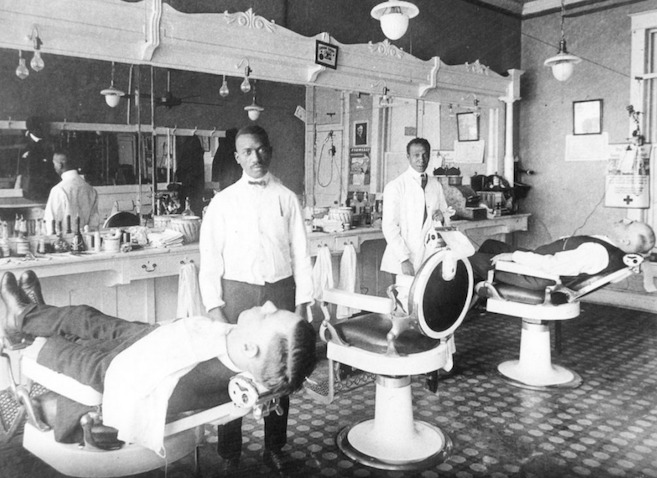
U.S. Barbershops could refuse service to blacks until 1964. Library of Congress.
My stylist recently opened his own business, moving on from the national Ulta Beauty Salons to the newer Salon Lofts, a European style shopping arcade of independent hairstylists. Commercial developer creates 20+ adjoining stalls in local strip mall; leases the space to stylists who wish to become private business owners; and collects their rents scot-free of any liability for their customer care.. A veritable flea market of cosmetology.
How and with whom they do business is now their call, each and all have a distinctive stall. Cougars surround the “Bend & Snap;" the “Wash & Set” has a wheelchair ramp. “Guns & Roses” offers whisky nips on a shelf with a jar marked “Cash or Tips!” It’s the American dream, or so it seems, except when they marginalize when feigning to fraternize. They say a stylist is a girl’s best friend, so why can’t I get into “G-A-Y Heaven?”
After many appointments at my former salon, I followed my stylist when I learnt he’d moved on. He was chic, professional, and fairly ripped, so I clicked on his website and scheduled a clip. The following day came his ego-trip:
Unfortunately, I am unable to take you on as a client. I do not think we are a good fit to work together. Thanks for thinking of me. I apologize for the inconvenience. Take care.
Should I sue, write a review, who should I talk to, what can I do? Do businesses in America have the right to refuse?
Signed,
Curl Up and Dye
Dear CU Dye:
In the United States, any business can refuse service to any person for any reason except race, color, religion, sex, and national origin. Here’s the backstory.
During Reconstruction, Congress passed the Civil Rights Act of 1875 which guaranteed everyone in America access to public accommodations. However, the Supreme Court in 1883 canceled that when they ruled Congress did not have the power to prohibit discrimination in the private sector. Associate Justice Joseph P. Bradley opines in The Civil Rights Cases:
The Thirteenth Amendment merely abolished slavery. The Fourteenth Amendment does not give Congress the power to outlaw private acts of racial discrimination.
But after nearly a century of systemic segregation in housing, transportation, and public accommodations, U.S. President John F. Kennedy proffered a "Report to the American People on Civil Rights" in 1963. It preceded Martin Luther King Jr.’s “I Have a Dream” — considered the most iconic speech in American history — and galvanized legislation ensuring all Americans the right to be served in facilities which are open to the public. He addressed the nation from the Oval Office:
This nation was founded by men of many nations and backgrounds. It was founded on the principle that all men are created equal, and that the rights of every man are diminished when the rights of one man are threatened.
The Civil Rights Act of 1964 — prohibiting private and public businesses from discrimination based on race, color, religion, sex, and national origin — soon followed and remains the unchallenged gold standard of civil rights across the nation. To the extent it’s vague: Masterpiece Bakery in Lakewood Colorado came under fire in 2012 for refusing to bake a wedding cake for a same-sex couple; Governor of Arkansas Sarah Huckabee Sanders was refused service by the Red Hen in 2018 when a Lexington Virginia restaurant escorted off the premises due to her political affiliation; and even Walgreens 8000+ drugstores empower pharmacists to step away from filling prescriptions if and when they have a “moral objection.”
When discrimination embeds itself into the laws and regulations of a society, they manifest as institutional racism in criminal justice, employment, housing, commerce, health care, education, public accommodations and politics. That's why New York City Mayor Ed Koch, who co-authored the Equality Act in 1974 said, "The time has come to rethink Plato's Ideal City, and certainly our own ideas about public accommodations in a modern republic."
The Equality Act remains a bill before Congress today, attempting to amend the Civil Rights Act to prohibit discrimination on the basis of sex, sexual orientation and gender identity in employment, housing, education, federally funded programs, and public accommodations. Legislation, incidentally, that can cut both ways.
It was the Greeks who first opposed in writ the notion of human equality. Specifically, Aristotle argued that women were inferior beings who cannot participate in society or politics because of their inability to reason; and decreed all manual laborer’s ineligible for education and citizenship in “Politics.”
Moreover, Plato called same-sex relationships “virtuous” in the “Symposium,” but condemned them as “unnatural, unholy, and detrimental to a stable state” in the "Laws.” Called the Father of Idealism, reality for Plato relied upon abstract, non-physical forms or ideas rather than the real world.
Enlightenment philosophers like Locke, Hume, Kant and Hegel constructed the arguments for institutional racism that advanced Platonic ideas and forms into laws. Specifically, they considered Black and Indigenous peoples the world over savage, inferior, and in need of correction by European Enlightenment. The architects of the 1705 Virginia Slave Codes invoked the Enlightenment thinkers in the first legislation, laws, and penal codes of slavery in the American Colonies.
Ultimately, their ideas influenced America’s founding fathers, who, declaring a nation rich with ideals in the salutary phrase of the U.S. Declaration of Independence, have yet to fully materialize into reality:
We hold these truths to be self-evident, that all men are created equal, that they are endowed by their Creator with certain unalienable rights, that among these are life, liberty, and the pursuit of happiness.
So of course you can sue, depending on what you can prove, or add to the milieu of Google reviews. However, you may wish to consider something entirely new. You're inalienable right of reply.
The “Right of Reply” is a legal term and opportunity to defend or correct a position in the same venue where it was first published. To become federal law, the Equality Act requires a simple majority in the House (218 of 435) and 60 votes in the Senate. H.R. 15 in the House, S. 1503 in the Senate, was reintroduced in the 119th Congress for the 2025-2026 legislative session. A republic is a form of government in which the supreme power belongs to the people, if and when they exercise it through their elected representatives.
And if and when codified into the U.S. Constitution, the Equality Act will update the Civil Rights Act to effectively democratize America’s marketplace. That’ll include Boystown, too. The U.S. Supreme Court's Adams v. Ohio just eased the burden of proof on reverse discrimination. So whether your a minority, or in the majority, Title VII universally prohibits discrimination against all members of a protected class. Which should in due course blow open the gates of “G-A-Y Heaven,” too.


Make sense of the week's news. Charlatan reviews the worldview.

Make sense of the week's news. Charlatan reviews the worldview.

Archives