The American Reckoning
As a blue tsunami rolls across the nation, MARY BONELLI ASHWORTH shows the Republic, Democracy, and the parties of “us and them” to the American kitchen table.
By Mary Bonelli Ashworth8 November 2026
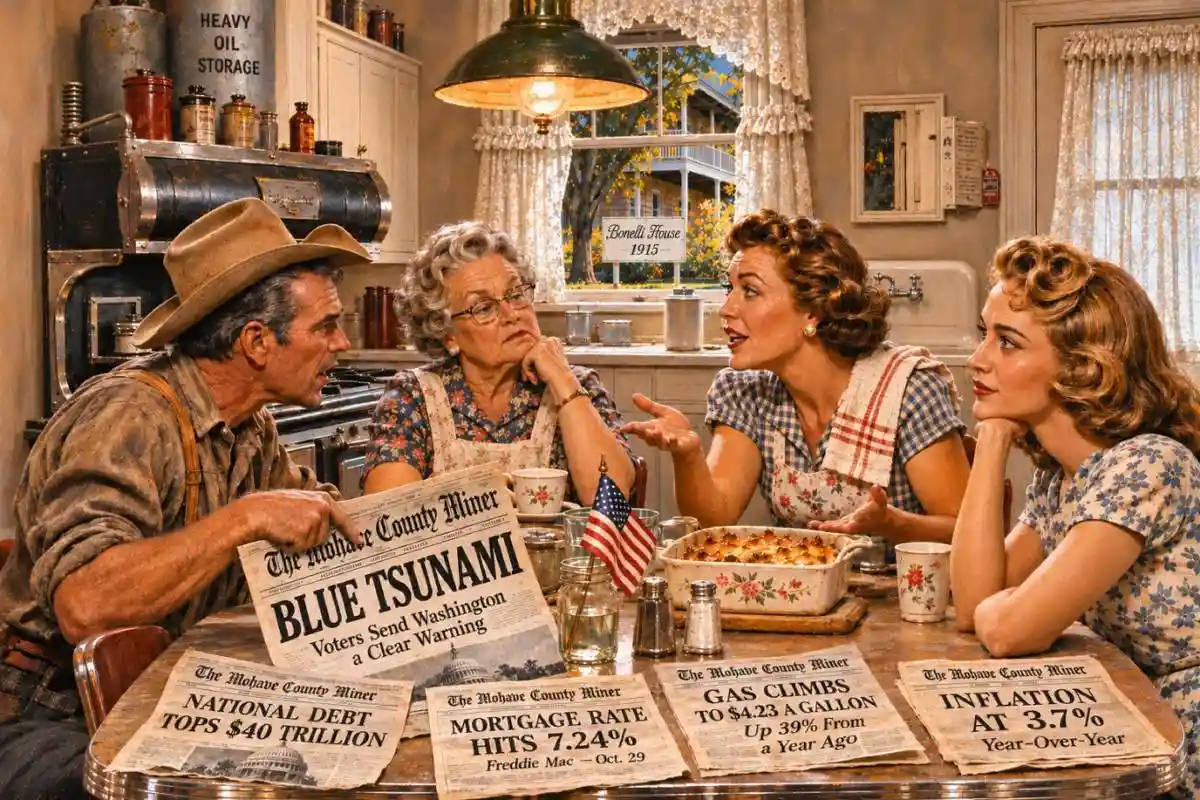
I started early, age six or so, listening to my parents around our kitchen table debate the New Deal, WWII, and a perceived threat and fear of socialism along with a smorgasbord of other concerns on the minds of Americans in the 20th century. A diminutive Democrat, mother was so astute in the psychology of active listening and soft assertiveness that Dad — a rancher nicknamed "Shake" for his love of great literature and works of Shakespeare — had to go toe-to-toe on everything from Red Rosie to Republican lore. Thirteen years her senior, what man can resist a woman so hopelessly devoted and in love?
Midterm elections have produced a predictable parade of parody and profundity from the media. In perspective, FDR lost 72 House seats, Obama 63 seats, Truman 56 seats, Clinton 54 seats, Eisenhower 48 seats, LBJ 47 seats and Trump 41. So, losing House and Senate seats is cyclical—like wildfires and typhoons. There is always a time of discombobulation and reset, but the resilience of the American people and their basic sense of fair play move us ahead. Washington, D.C., and Los Angeles elected democratic socialist mayors, joining New York City and Seattle. Texas has elected the first Hispanic woman governor to hold the office in the state’s history, and the first Democrat to be elected governor in 36 years. Florida, the third most populous state in the Union, elected its first Black governor, and New Hampshire elected the first openly gay man to ever serve in the U.S. Senate. A record 124 million voters turned our for the midterms — the most in any midterm election cycle in the nation's history — to confirm that voters no longer have loyalties to one particular identity group. They are now more than ever before collectively concerned about the nation.
It can fairly be said that two subjects we should never discuss in polite company are religion and politics. As an octogenarian, however, I feel that those are the two things that must be discussed! An evening spent with family, friends, and new acquaintances (in private, not public) while sharing differing points of view can prove far more interesting than Insta. Here, all opinions are welcome, and ideas so often presented in story form allow the younger participants to experience the aha moment on their own, rather than by some didactic form of insistence from an adult or algorithm. “Good thinking” was an often-heard phrase of encouragement.
Good thinking," was an often-heard phrase of encouragement.
Americans believe in fair play. Today, with occasional candor almost venomous in nature, they speak of the $3,000,000,000 daily interest payment on the national debt. I’m sorry, but I did the family budget and primitive accounting, so named because my husband majored in accounting and got a master’s degree in tax law. In his heart he wanted to pursue dentistry, not endless numbers in columns on green paper. Which is why I inherited the job, blithely using music paper lined with the grand staff. Primitive, indeed. If the results were doleful, I could compose a few morose measures in C-sharp minor, and on better financial days even write a quick song of gratitude in the key of G major for unnumbered blessings. After tallying up all the pertinent numbers, Don skipped dentistry and went on to become an attorney, probate commissioner, and state senator. All the while having no penchant for conflict. Married for 50 years, Don and I didn't always agree. But we never argued.
As we raised our children, it was essential to factor in scout trips, dancing lessons, basketball uniforms, braces, choir trips, prom dresses, and of course mission funds and college tuition for our seven scholars offset by monthly sojourns to our family ranch in Gunlock. The budget had to be balanced, and our nation’s budget must be, too. Because three billion a day for interest on a loan is reprehensible, not to mention unsustainable.
Still, I remain an optimist. In the past, Americans have made experimental trips into non-constitutional paths. Like a canary sent down a mine shaft, they always returned sorely disappointed. Only to adjust the trajectory, make the needed changes, and apply the new knowledge to best practices. Emblazoned on the wall in my workroom is a Zen saying: “After enlightenment there is still the laundry.”
They’ve been called the cornerstones of humanity: where the crossroads of communication, language, and compassionate care collided into the very cradle of civilization. At the epicenter of thought, learning and change, I've listened in to both sides of the argument over several generations and learned how to debate disparities and discuss solutions. All the while laying the table, clearing plates, and doing the washing up with gleam. Ronald Reagan said in his farewell address: “All great change in America begins at the dinner table.” And no matter where life takes us, the kitchen table is where we all return.